Decide Smarter.
Start Today
Popular Articles

![Decision AI: Modern Decision Intelligence Stack [Part 2 of 2]](https://cdn.prod.website-files.com/69079d5bc1a99349b566161a/69b293b82dc44eb19c6ba0d7_thumbnail%20short%202.png)

.png)
.png)
.png)
.png)
.png)
Every knowledge graph ever built stops at retrieval. The Ontology State Graph is where reasoning begins. An argument and why the difference changes everything for enterprise AI.
Three contrasts. One argument. Everything enterprise AI has built so far stops at the first column - and your strategy is paying for it.

The knowledge graph earned its place. It gave enterprise AI structured context — entities, relationships, the semantic foundation that separates serious AI from keyword search. The category is real. The value is real. It deserved to win.
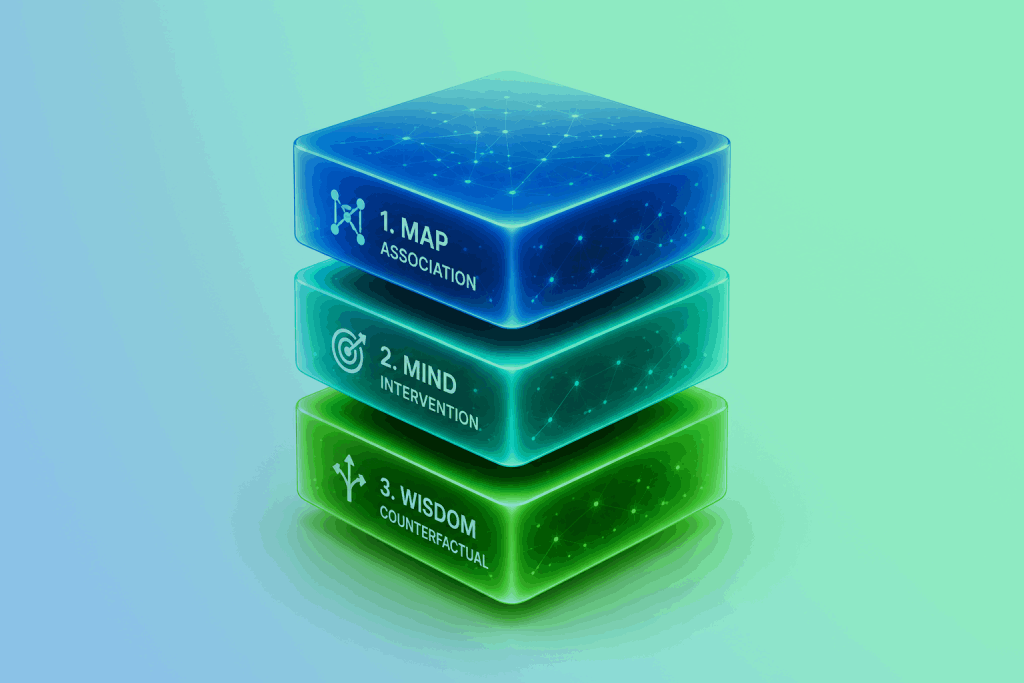
But a map, however detailed, remains a map. It shows you the terrain. It does not tell you why someone chose to cross it, what they were trying to reach, or whether the route held up. For that you need something a map has never been: a mind.
"While probabilities encode our beliefs about a static world, causality tells us whether and how probabilities change when the world changes — be it by intervention or by act of imagination." - Judea Pearl - Turing Award · The Book of Why, 2018
Pearl's ladder of causation defines three levels of intelligence: association (what correlates), intervention (what happens if we act), counterfactual (what would have happened if we decided differently). A knowledge graph operates at level one — association, however sophisticated the traversal. Enterprise strategy requires all three. The Ontology State Graph is the first enterprise architecture designed to reach them.
The metadata trap — and why it was never going to be enough
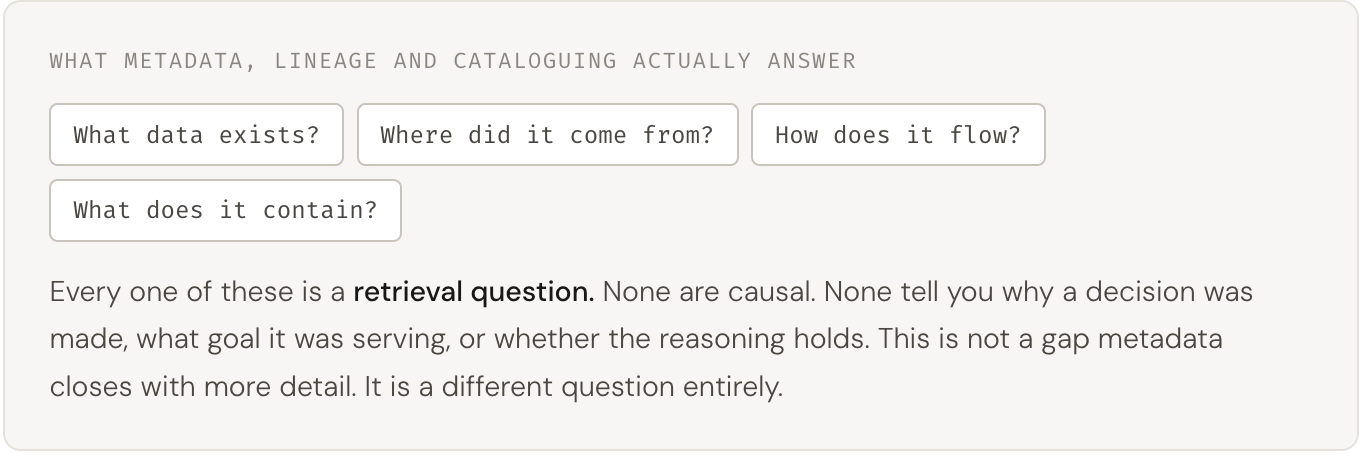
The metadata era made a seductive promise. More data. Better lineage. Richer catalogues. The implicit assumption was that visibility equals understanding. That a sufficiently detailed map eventually becomes a mind.
It does not.
"The most important figures that one needs for management are unknown or unknowable — but successful management must nevertheless take account of them - W. Edwards Deming - Statistician · Father of Total Quality Management
Deming understood what the metadata category forgot: the most consequential information in any enterprise cannot be catalogued. It is the reasoning behind decisions — the intent behind a market call, the goal a strategy was actually serving, the logic that seemed sound at the time. Metadata organises your data estate. It does not govern how your enterprise reasons about it.
The result is a software crisis — point solution after point solution, each cataloguing a different corner of the estate, each building a better map. None of them were ever going to answer the question that drives every strategy review, every post-mortem, every board conversation: why did we decide that — and should we do it again?
What a map cannot tell you
A knowledge graph creates this illusion at enterprise scale. It surfaces what happened with such fluency that it mimics understanding. But retrieving outcomes is not reasoning about decisions. The map looks so complete that organisations mistake it for a mind — and build strategy on it accordingly. When something goes wrong, there is all the data and none of the answers.
To be precise: knowledge graphs do perform relational reasoning — multi-hop traversal, entity inference, relationship modelling. But in Pearl's terms this is still the first rung: association. Knowing A relates to B and B relates to C tells you nothing about why a decision connected them, what goal it was serving, or whether the logic holds under different conditions. That is the dimensional gap. Not a missing feature. A missing layer.
When something goes wrong in your enterprise — a forecast misses, a strategy unravels, a market call fails — you have all the map and none of the mind. The causal layer that recorded why was never built. And no amount of richer metadata closes a gap that is dimensional, not descriptive.
Three layers that close the gap
Building a mind requires a compound system. One that starts with the map but adds the two dimensions the map was never designed to carry.

Your Ontology State Graph :
Where all three layers converge | Domain. Data. Decisions

Not a flat knowledge graph. Not a metadata catalogue. A living, three-dimensional causal reasoning fabric — updated as your agents learn, your humans decide, and your business evolves. The transition from map to mind. From retrieval to reasoning. From metadata and lineage to causal decisions. This is what enterprise AI has been missing. And on May 19th, we're building it live.
Metadata platforms solved a real problem. Cataloguing. Lineage. Discovery. Every enterprise needs this. The category earned its place. But they were built to answer what do we have — and that question produced a software crisis of point solutions. The Ontology State Graph is not a better map. It is the architecture enterprise AI always needed and never had.


Ranjan Kumar, Founder & CEO, DecisionX
Ranjan Kumar is the Founder and CEO of DecisionX AI, the world’s first self-learning, context-aware Decision Intelligence platform that enables enterprises to make smarter, faster business decisions through agentic AI. A serial entrepreneur and three-time founder with over 17 years of experience, Ranjan previously built Entropik, the world’s first Emotion AI platform with 17 global patent claims. An IIT Kharagpur alumnus, he is widely recognized as a thought leader in enterprise AI, Ontology Engineering, decision reasoning, and AI-driven business transformation.