Decide Smarter.
Start Today
Popular Articles


![Decision AI: Modern Decision Intelligence Stack [Part 2 of 2]](https://cdn.prod.website-files.com/69079d5bc1a99349b566161a/69b293b82dc44eb19c6ba0d7_thumbnail%20short%202.png)

.png)
.png)
.png)
.png)
.png)
The AI industry spent twenty years building retrieval infrastructure with extraordinary precision. Nobody built the other direction. Here is why and why that changes now.
Everyone built backward.

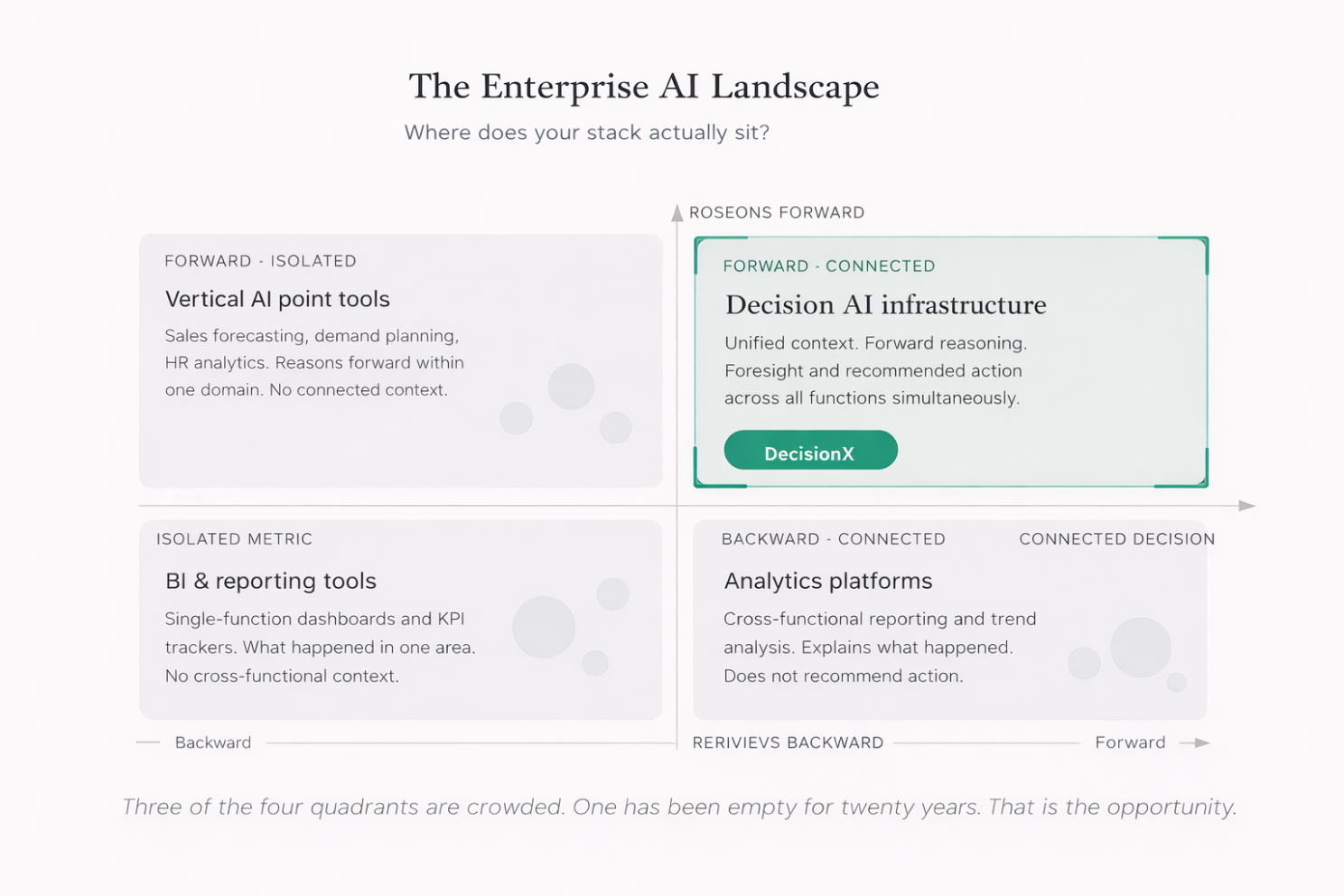
Every analysis type your organisation runs sits somewhere on this axis. Most enterprise AI investment has gone into the left half. The right half has been empty for twenty year
Right now, somewhere in an enterprise, a decision is being delayed.Not because the data does not exist. It does. It is in three dashboards, 1 CRM, two spreadsheets, and a deck someone built last quarter. The delay exists because none of those sources can answer the question that actually needs answering:
What should we do — and what happens if we do it?
That question is sitting in a room full of informed people, waiting for a 10-day analyst sprint that will arrive after the window to act has already narrowed.
This is not a failure of intelligence. It is a failure of infrastructure.

Not lost. Leaked. Through the gap between knowing and deciding.The tension is not that the tools are bad. The tension is that they are facing the wrong direction. Which raises the obvious question: why was the other direction never built?
The lesser built half
Two decades of enterprise AI investment. Billions of dollars. All pointed at one question:
What happened?
The forward direction - what should we do, and what happens if we do it? - was seen. It was understood. It simply was not built with the same rigour, investment, or infrastructure as retrieval.
The reason is incentive structure. Retrieval produces visible outputs that win budget cycles. A dashboard is demonstrable in a board meeting. A reasoning layer produces better decisions — validated only by outcomes, weeks later, invisibly. Invisible value does not win funding rounds.
An entire infrastructure category - the reasoning layer - consistently under built while the industry optimised harder and harder in the opposite direction.
To understand why this happened — and why it matters — you have to understand what "direction" actually means when it comes to AI.
The Direction Problem
Enterprise AI has been built facing backward. The tools are excellent. The direction is wrong.The direction of a question determines the direction of the analysis required to answer it.
Retrieval moves backward - from the present into data, into history, into what has already occurred. Optimised for accuracy about the past. It answers: what happened, why did it happen, how does it compare.
Reasoning moves forward - from the present into consequence, into trade-offs, into the outcome of a commitment before it is made. Optimised for confidence about the future. It answers: what should we do, what happens if we do it, what are we trading away.
These are not two points on a single spectrum. They are different architectural requirements, different data primitives, different output types, and different infrastructure categories entirely. For twenty years, enterprise AI built one. The other went unbuilt. And you can see exactly where the divide falls when you map every analysis type your organisation runs against it.
Where every analysis type actually sits
The divide is not abstract. Every analysis type an organisation runs sits on one side of this line - and most organisations have never mapped their stack against it.

Most organisations have built sophisticated, well-integrated infrastructure for everything in the retrieval column. Almost none have infrastructure for anything in the reasoning column. This is not a gap in analytical sophistication. It is a gap in direction. And it did not happen by accident.
Why the gap persisted - and why it matters for the ecosystem
Understanding why the reasoning layer went unbuilt for so long is important — because it explains precisely why the opportunity is real, and why it is still available.
The answer is incentive structure, not capability. LLMs did not exist in the form required. Orchestration primitives were not mature. Ontology-based context graphs at enterprise scale were not production-ready. These are genuine technical prerequisites that have only recently become available.
But more importantly: the market signal was distorted.
Retrieval infrastructure produces visible, attributable, demonstrable outputs. A BI tool ships a dashboard. The dashboard is in a meeting. The ROI case is straightforward. The procurement cycle is familiar.
Reasoning infrastructure produces better decisions. Decisions are validated by outcomes. Outcomes appear weeks later, entangled with a dozen other variables, with no clean line back to the reasoning system that shaped the call.
This is why every AI company that looked at the reasoning layer looked away. The technical difficulty was real. The market signal was weak. The retrieval market was large, growing, and legible.
Category creation changes the signal.
Once "Decision AI" is a named category - once Gartner publishes a Magic Quadrant, once enterprise buyers begin asking for it by name, once the vocabulary exists - the market signal becomes legible. The reasoning layer becomes a procurement line item. The ROI case becomes standard.
We are at that inflection point right now.
What building the reasoning layer actually requires — the architecture, the primitives, the infrastructure components that make forward reasoning possible at enterprise scale — is a different conversation. One worth having in full.
But the category that delivers it already has a name.
The category this defines
Decision AI is not a smarter dashboard. It is not an analytics platform with an AI layer on top. It is not a chatbot that queries a data warehouse.
Decision AI is the infrastructure built specifically for the reasoning layer — the forward-facing half of the enterprise AI stack that has been missing since the beginning.
Gartner published its first Magic Quadrant for Decision Intelligence Platforms in January 2026. The market is being evaluated formally for the first time. The vocabulary is forming.
For the AI ecosystem, this is the moment.
Not the moment to build another retrieval tool with a reasoning feature bolted on. The moment to build the reasoning layer properly — with the architecture it actually requires, the persistence it depends on, the context it needs to function, and the decision-intent framing that makes it genuinely different from everything that came before.
The database did not make the spreadsheet obsolete. It created a new layer that the spreadsheet could not become.
The reasoning layer is that kind of opportunity - not a replacement for what has been built, but the missing half that completes it.
The Direction Problem is not inevitable. It is a structural gap that remained open because the conditions to close it did not exist. Those conditions now exist.
The unbuilt half is available to be built. The only question is who builds it.


Ranjan Kumar, Founder & CEO, DecisionX
Ranjan Kumar is the Founder and CEO of DecisionX AI, the world’s first self-learning, context-aware Decision Intelligence platform that enables enterprises to make smarter, faster business decisions through agentic AI. A serial entrepreneur and three-time founder with over 17 years of experience, Ranjan previously built Entropik, the world’s first Emotion AI platform with 17 global patent claims. An IIT Kharagpur alumnus, he is widely recognized as a thought leader in enterprise AI, Ontology Engineering, decision reasoning, and AI-driven business transformation.