Decide Smarter.
Start Today
Popular Articles


![Decision AI: Modern Decision Intelligence Stack [Part 2 of 2]](https://cdn.prod.website-files.com/69079d5bc1a99349b566161a/69b293b82dc44eb19c6ba0d7_thumbnail%20short%202.png)

.png)
.png)
.png)
.png)
.png)
Part 1 of this series traced the thirty-year arc of business intelligence - from reports to dashboards to agents - and argued that every generation moved the answerable question one step closer to what strategy leaders actually need, without ever reaching it. The question that remains is: given everything we know, what should we do?
Answering it requires something that enterprise software has never built. Not a better data layer, not a smarter agent, but a formalization of how organizations decide - the governance logic, the trade-off policies, the judgment that experienced operators carry in their heads and transmit through conversation. SaaS captured the outputs of organizational cognition. It never captured the cognition itself.
This wasn't an oversight. It was a technical impossibility - until recently.
Intelligence Is Not Cognition
These two things get conflated constantly in the current AI discourse, and the conflation matters because it leads organizations to conclude that better models are the solution to a problem that better models cannot touch.
Intelligence, in the sense that foundation models provide, is the capacity to reason, generate, predict, and synthesize across data. Model capability compounds with compute. The cost of intelligence falls. There is no durable moat in the intelligence layer - Richard Sutton's Bitter Lesson, that general methods at scale beat hand-engineered features, holds in full.
Organizational cognition is different. It is the set of structures that define what the organization is deciding, under what governance, with what trade-offs acceptable. It is not a capability. It is a grammar - and it is organization-specific in a way that no foundation model can learn from external data, because it does not exist in any external data source. It lives in the organization's decision history, its governance structures, and the judgment of its people.
The relationship between the two is not competitive. Better intelligence raises demand for formalized cognition, because every model improvement expands the scope of what an organization can attempt to reason over - which means more of its cognitive structure needs to be explicit for that reasoning to produce anything useful.
Steve Jobs articulated this dynamic through Pixar. In the 1990s, rendering a frame took three hours. Computers got faster. How long did it take by the 2010s? Still three hours - because every time compute improved, Pixar made more ambitious films. More characters, more complex lighting, more scenes. The capability improvement created proportionally higher demand at the layer that decided what to do with it. Better models don't compress the need for organizational cognition to be formalized. They raise the frontier of what needs to be structured.
Why Decision AI Is Possible Now
The reason organizational cognition was never formalized is that doing it required a technical substrate that didn't exist. Capturing how an organization decides means representing judgment in a form flexible enough to hold the messy, conditional, contextual nature of real decisions - and structured enough that an AI system can reason against it systematically. Prior approaches required choosing one or the other.
Schema-based systems could structure decision logic rigorously. They work well in domains where governance frameworks are stable enough to be hand-modeled by engineers - defense supply chains, government operations. In commercial enterprise, where a pricing change in March invalidates a decision structure built in January, that approach breaks before it ships.
Knowledge and activity platforms capture the trail of how work happened. They can tell you a decision was made, surface the document associated with it. They cannot tell you what the decision encoded about how this organization thinks - the trade-off logic, the constraint it was operating under, the precedent it set.
What changed is that language models can now bridge this. The interface between human judgment and machine structure no longer requires a data engineer in the middle. A Chief of Staff can say: "When the CEO is choosing between two market entry paths, she weights the strength of existing customer pull over market size - and will not commit resources to a market where we don't have a named champion at the VP level or above." That rule has never existed in any system. It lives in the CoS's head, learned over two years of being in the room. Now it can become part of the decision context layer - in a form the AI can reason against when the next market entry question surfaces, whether or not that CoS is still in the organization.
The cognition capture problem is, for the first time, technically tractable.
The Stack
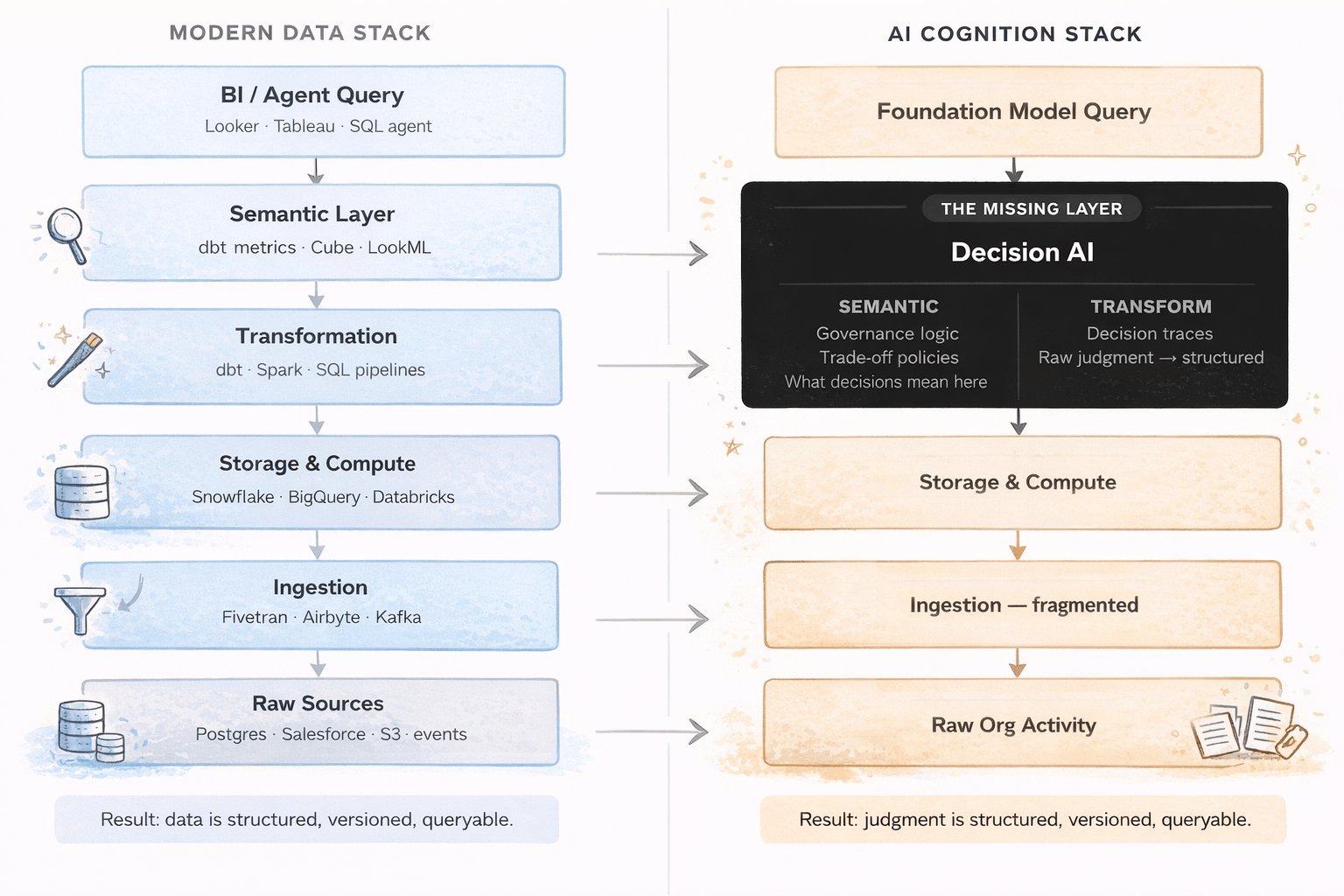
For decades, enterprise software had two layers: data infrastructure at the bottom, workflow and process tools on top. AI adds two more: intelligence (foundation models) and cybernetics (agents). These are powerful. They are also directionless without something beneath them that tells them what to optimize for, what governance applies, what precedent is relevant.
The Decision AI layer sits between an organization's data and its AI capabilities. It translates "here's what the data says" into "here's what this means for the decision we're actually trying to make." Without it, AI in the enterprise is a productivity tool - faster execution of existing workflows. With it, AI becomes infrastructure for consequential choices. That is a categorically different proposition.
The Infrastructure Parallel
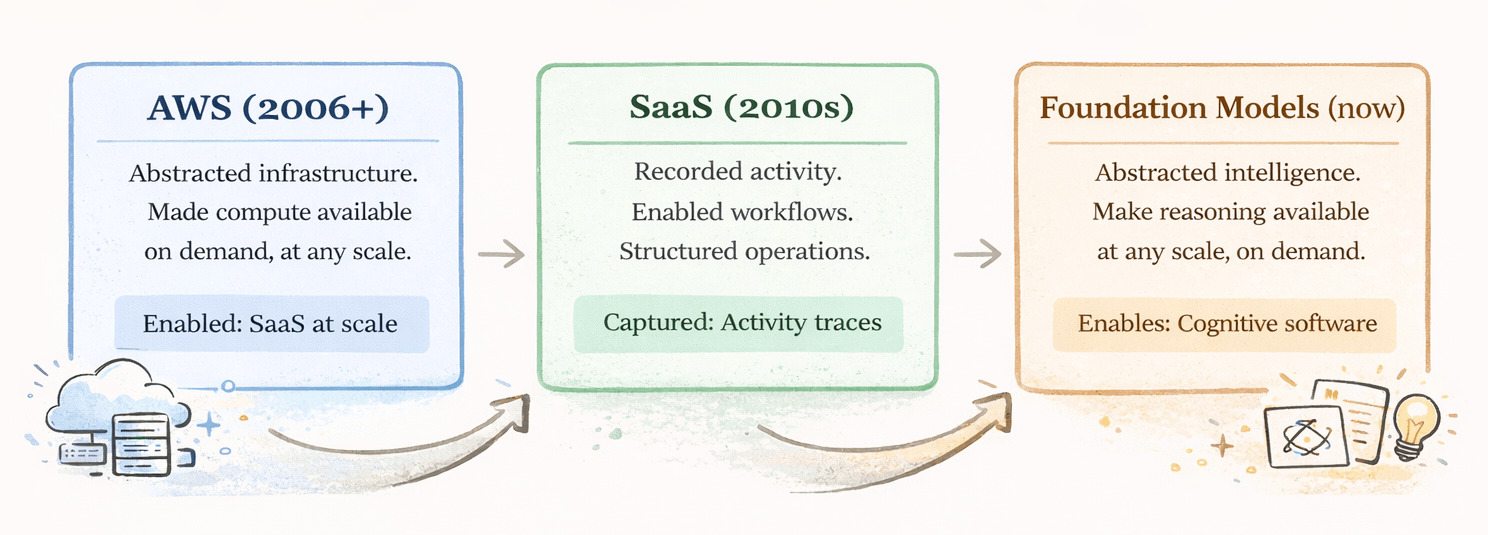
AWS didn't build SaaS applications. It abstracted infrastructure - made compute available on demand at any scale - and created the economic conditions under which a new category of software became viable. Salesforce didn't exist before AWS-era infrastructure made it practical to run CRM in the cloud. And what Salesforce actually did, in structural terms, was formalize something that had previously lived in human memory: customer relationship management, which before CRM existed in rolodexes, email threads, and the heads of individual sales reps. The category created value not by adding intelligence but by making tacit organizational knowledge explicit and queryable.
Foundation model providers are playing the analogous infrastructure role now. They are abstracting intelligence - making reasoning available at scale - and creating the conditions under which a new category of software becomes buildable. What AWS made possible for workflow software, foundation models make possible for cognitive software. The new category being built on this infrastructure formalizes what has always lived in human memory: organizational judgment - the governance logic, the trade-off policies, the decision history that experienced operators carry and that leaves with them when they go.
Harvey AI did this for legal reasoning - took the judgment structure of legal work and made it available at scale within a firm's specific precedent context. The next generation of platforms is doing it for organizational strategy and execution. The intelligence layer is horizontal and will commoditize. The judgment layer - vertical, organization-specific, compounding with every decision made through it - is where durable value accumulates.
What Compounds Differently
The switching cost for a well-embedded Decision AI platform is not contractual. It is cognitive. The organization's decision intelligence - its traces, governance logic, precedent library - accumulates in a system built over time and cannot be reproduced from outside. Every decision made through the system adds to the institutional record. Governance becomes explicit. The organization's judgment becomes less dependent on which individuals happen to be in the room.
This is the layer that has been missing from the enterprise software stack since the first dashboard shipped. It is now buildable. The organizations that treat this as an architecture decision now - rather than a feature to evaluate later - are the ones whose AI will actually get more useful over time, rather than more capable but no more purposeful.


Ranjan Kumar, Founder & CEO, DecisionX
Ranjan Kumar is the Founder and CEO of DecisionX AI, the world’s first self-learning, context-aware Decision Intelligence platform that enables enterprises to make smarter, faster business decisions through agentic AI. A serial entrepreneur and three-time founder with over 17 years of experience, Ranjan previously built Entropik, the world’s first Emotion AI platform with 17 global patent claims. An IIT Kharagpur alumnus, he is widely recognized as a thought leader in enterprise AI, Ontology Engineering, decision reasoning, and AI-driven business transformation.