Decide Smarter.
Start Today
Popular Articles


![Decision AI: Modern Decision Intelligence Stack [Part 2 of 2]](https://cdn.prod.website-files.com/69079d5bc1a99349b566161a/69b293b82dc44eb19c6ba0d7_thumbnail%20short%202.png)

.png)
.png)
.png)
.png)
.png)
Why Decision AI is the missing layer between AI capability and strategic outcome
In 1870, the Prussian army defeated France in six weeks. France was comparably armed and had comparable soldiers. The decisive advantage was structural: the Generalstab. A system developed over fifty years specifically to solve the problem of scaling judgment across a distributed organization. Not orders, not data, not even strategy documents - but decision doctrine. A formalized, transmissible structure for how Prussian commanders resolved trade-offs under novel conditions without waiting for direction from above.
The Generalstab didn't tell commanders what to do. It gave them a shared grammar for deciding. That grammar, replicated across every level of the organization, compounded into a decisive strategic edge.
We are building every piece of the modern equivalent. Except that one.
Intelligence is everywhere. Cognition is nowhere.
Every organization running AI today has access to more analytical capability than any strategy team in history. Models that synthesize, predict, reason. Agents that execute across systems. Platforms that connect data and coordinate workflows. The productivity gains at the individual level are real.
And yet the question that sits at the end of every strategy conversation - given everything we know, what should we do? - remains almost entirely unanswered by any of it.
The strategy problem that gets framed wrong
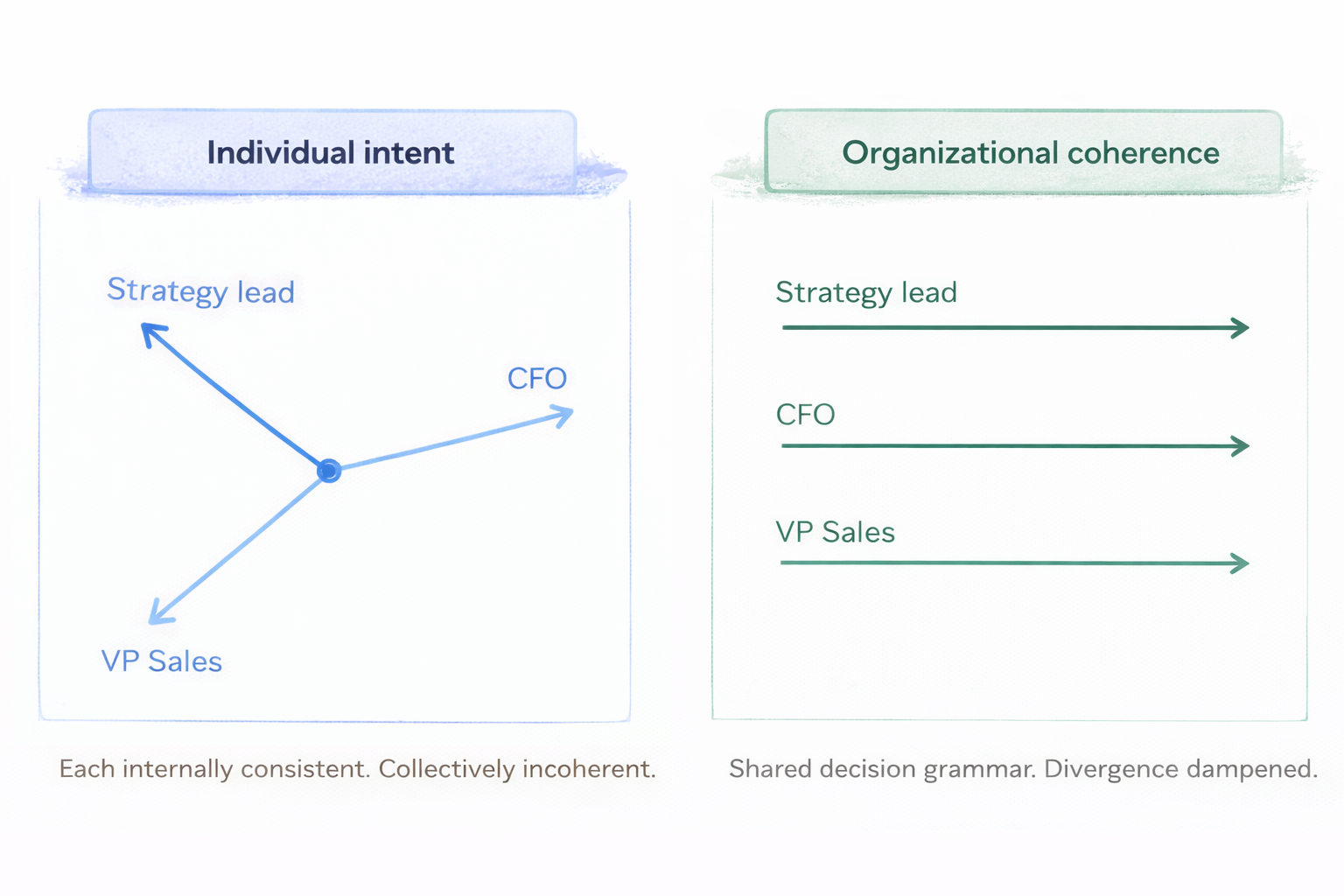
Strategy is not an information-retrieval problem. It is not an execution problem. It is a coherence problem - specifically, the problem of maintaining coherent organizational intent across time, across people, and across changing conditions.
Coherence breaks in a recognizable way. Not because people lack information or intelligence. Because the organization's understanding of its own priorities, trade-offs, and constraints is distributed across individuals - and that distribution creates divergence every time conditions shift, people change, or a hard call gets made without the right person in the room. Each individual remains internally consistent. The organization, in aggregate, does not.
This divergence is structural. It would exist even with perfect data, perfect models, and perfect execution coordination - because none of those address the coherence problem. They assume coherence is already present. They are built to scale what the organization has already decided. The harder problem - maintaining a shared, live, computable model of how the organization decides, under what constraints, with what trade-offs acceptable - has never had infrastructure built for it.
That is what Decision AI is.
What maintaining coherence actually requires
Decision AI has 4 core properties that form the bedrock of it:
- Information Access vs. Accumulation
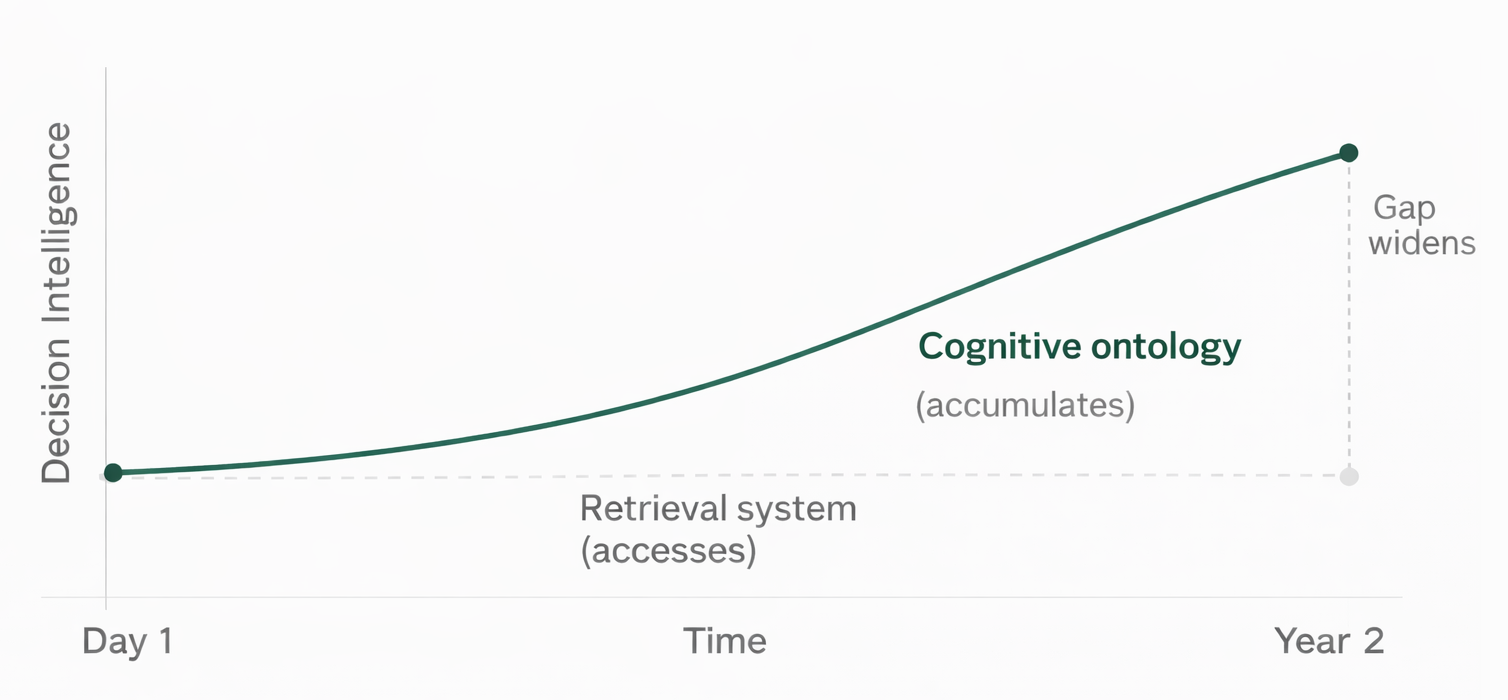
Data platforms give agents access to information.
The strategy layer needs something that accumulates - that gets more intelligent about how this specific organization decides with every decision made through it.
The cognitive ontology becomes the coordination medium: a structured, living representation of the organization's trade-off logic, governance state, and decision precedents.
A grammar of organizational judgment that compounds over time, not a retrieval system over past outputs.
- Decisioning Governance vs. Data Permissions
Enterprise platforms solve identity and access: who can see what data, which agents can act in which systems. Strategic governance is a different question.
At what threshold does a pricing decision require CEO sign-off rather than VP authority?
What constraints are non-negotiable in this quarter's resource allocation?
What is the live authority structure for a market entry call?
These structures shift with every leadership transition, board review, and change in strategic posture. They cannot be configured in a permissions layer. They require a system that captures live decision authority as an organizational state.
- Foresight vs. Analysis
Business intelligence has spent 30 years moving the answerable question closer to what strategy leaders actually need - from reports to dashboards to agents that query data conversationally.
It has not answered: given current internal signals and external conditions, what is likely to happen under different choices, and what should we do? Answering that requires combining the organization's live strategic assumptions with external signals to generate probable futures and surface the next best action. Analysis explains the past. Foresight reasons from the present toward decisions. The infrastructure for that has never existed in any enterprise system, and it can’t quite exist without the decision context layer beneath it.
- Precedent vs. Pattern
Generic AI finds statistical patterns across data. Strategic reasoning requires structural precedent: this organization, facing this trade-off, under these constraints, resolved it this way, for these reasons, and here is what happened. The distinction matters because precedent allows an organization to reason about whether a current situation rhymes - whether the structural conditions that made a prior resolution correct still hold today. That is institutional memory with causal structure. No pattern library gets you there.
The Generalstab problem hasn't been solved yet.
The Prussian advantage was a judgment-scaling advantage.
A structure that allowed strategic cognition to be transmitted across an organization without being bottlenecked by any single person's presence in the room.
Every scaling organization faces the same constraint. You cannot be in every meeting. Your best strategist cannot clone herself. The decisions that compound into outcomes are distributed across dozens of rooms, dozens of moments where someone is operating on implicit assumptions about what the organization values and how it decides.
Individual intelligence makes each of those moments more capable.
Execution coordination connects them.
Data coordination informs them.
None of that maintains coherence.
Within two years, every company at your competitive level will have access to the same models at roughly the same cost. The organizations that separate will not be distinguished by what their AI can do. They will be distinguished by whether their AI understands what they are trying to accomplish - and gets sharper at that understanding with every decision made through it.
That is the Generalstab problem. It now has an answer.
Decision AI.



Ranjan Kumar, Founder & CEO, DecisionX
Ranjan Kumar is the Founder and CEO of DecisionX AI, the world’s first self-learning, context-aware Decision Intelligence platform that enables enterprises to make smarter, faster business decisions through agentic AI. A serial entrepreneur and three-time founder with over 17 years of experience, Ranjan previously built Entropik, the world’s first Emotion AI platform with 17 global patent claims. An IIT Kharagpur alumnus, he is widely recognized as a thought leader in enterprise AI, Ontology Engineering, decision reasoning, and AI-driven business transformation.