The Data Fragmentation Problem: 6 Spreadsheets, 10 Slides, No Clarity
.png)
Decide Smarter.
Start Today
Popular Articles


![Decision AI: Modern Decision Intelligence Stack [Part 2 of 2]](https://cdn.prod.website-files.com/69079d5bc1a99349b566161a/69b293b82dc44eb19c6ba0d7_thumbnail%20short%202.png)

.png)
.png)
.png)
.png)
.png)
A number moves. Three teams give three different explanations. Your company's logic sits in people's heads, not in any system.
This happens every day. Finance has one spreadsheet. Marketing has another. Sales has a pipeline template they guard like classified intel. Your dashboards show a version of the truth, but nobody fully trusts them. Strategy is scattered across ten PowerPoint decks from different quarters.
So you start stitching. Bounce between tabs. Cross-check filters. Compare exports. Search your inbox for the final_final file. Scroll through Slack threads to find a number someone mentioned last week.
A ten-minute decision now eats half your afternoon. Momentum dies right there.
This is not a data issue. It is a fragmentation issue. And it is costing your team real time, accuracy, and attention.
The Scale of the Problem: Data Fragmentation Statistics
Recent surveys quantify what most professionals already feel:

When this is the daily reality, even basic decisions become heavy.
The Everyday Decision Crisis: How Fragmentation Compounds
Every professional knows this loop. Whether you're a founder, analyst, or team lead, your day looks the same.
The typical workflow:
- Start in Excel
- Jump to a dashboard
- Check a Slack thread where someone shared a CSV
- Open PowerPoint to see last quarter's narrative
- Text a colleague to ask if they have the updated numbers
None of these tools talk to each other. None remember what you already figured out. Each one requires you to translate context from the last tool into the next.
You're not short on data. You have more data than ever.
What you're short on is clarity. The bridge that connects numbers to meaning. The thing that turns isolated facts into actual decisions.
Every hour spent reconciling files is time stolen from thinking.
Why Current Business Intelligence Tools Make Fragmentation Worse
These tools were not built to work together. They were built to do one thing well.
How Traditional BI Tools Handle Data
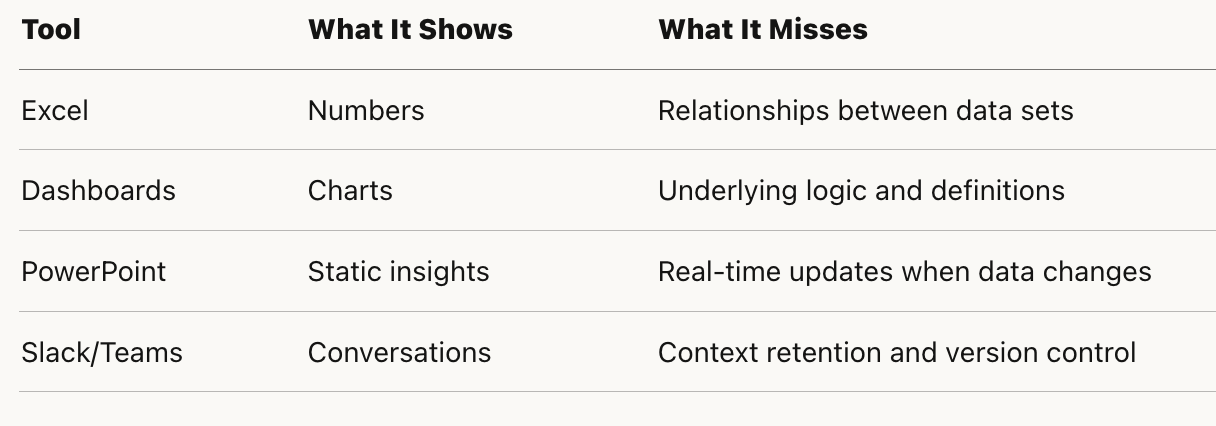
They were never designed to function as an audit layer.
Why Generic AI Models Fail on Business Data
Even when you turn to general-purpose AI like ChatGPT or Claude, you hit the same wall.
What generic models cannot do:
- See the structure behind isolated files
- Know your business definitions
- Understand that your pipeline feeds your bookings
- Map how bookings connect to revenue
They guess based on fragments. You get neat explanations that collapse when compared to the actual numbers.
This is the human bandwidth bottleneck. Your team's capacity for reasoning is capped by how much one person can hold in their head while jumping between six different systems.
The Silent Cost of Data Fragmentation in Business
When insight depends on manual work, two things break immediately.
1. Decisions Slow Down
Not because teams are lazy. But every conclusion requires:
- Chasing versions across systems
- Re-explaining context to stakeholders
- Validating assumptions across multiple sources
By the time clarity arrives, the market has moved.
2. Quality Suffers
When context lives in ten places at once, something always gets dropped:
- A nuance from a Slack conversation doesn't make it to the spreadsheet
- A recent dashboard change doesn't get reflected in the PowerPoint
- Teams debate which version of the truth to trust instead of debating strategy
In fast-moving businesses, this compounds. Opportunities fade while teams are still reconciling data. Leaders lose momentum not because they lack intent but because they lack integrated reasoning.
The real constraint: We live in a world with infinite data but finite human cognition. Every tool that sits in isolation makes it worse.
What You Actually Need: Decision Intelligence vs Business Intelligence
You do not need another spreadsheet. You do not need another dashboard. You do not need another tool that shows more data.
Decision Intelligence Platform Requirements
A decision intelligence platform must:
- Bring your data together across all sources
- Understand the relationships between your files
- Connect numbers to meaning without manual stitching
- Work across all formats (spreadsheets, dashboards, reports, slides)
- Preserve logic when something changes
You need reasoning. Not visualization. Not language generation.
Actual reasoning means: Here is what happened. Here is why it happened. Here is what we should do next.
How Green Solves the Data Fragmentation Problem
Green is built for professionals drowning in fragmented data.
How Green Works
Step 1: Upload your data: Upload your spreadsheets, CSVs, reports, and slides. Green reads them all.
Step 2: Green learns relationships: It understands how your files connect. It maps your sales data to marketing data to financial data. Not in a database that requires months to set up, but immediately, by learning the logic behind how your business works.
Step 3: Ask questions, get reasoned answers
Real Green Use Cases
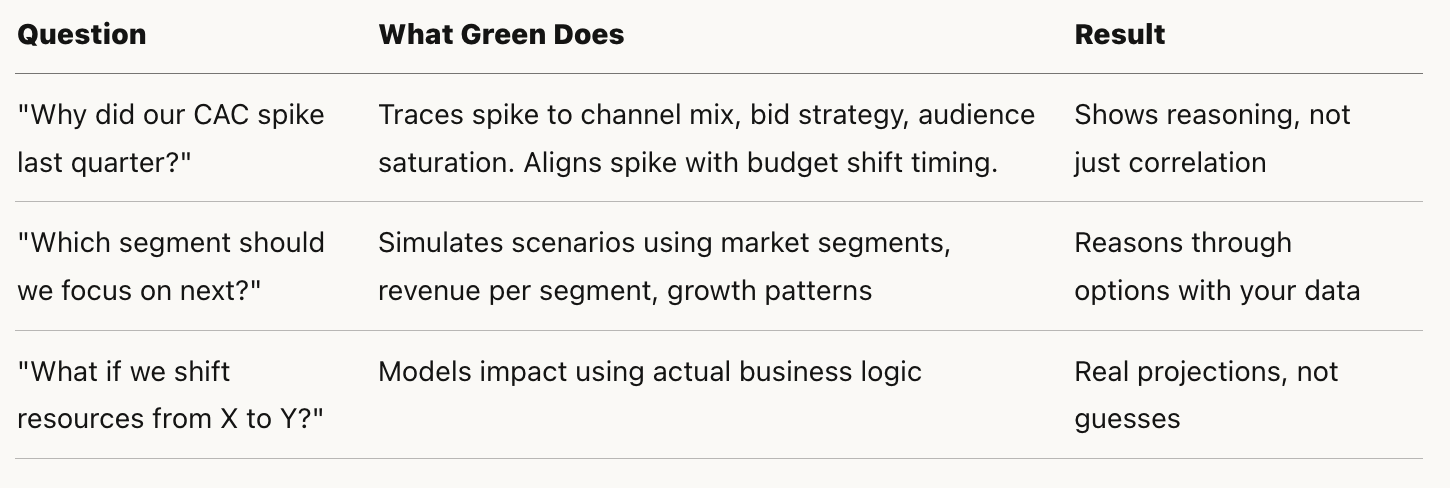
This is reasoning. Not visualization. Not description. Real understanding that gives your team hours back and sharpens every decision you make.
The Future of Business Intelligence: From Data Collection to Reasoning
The bottleneck in your business is not data. It is reasoning.
Every professional and every team deserves a partner who can think with them. Not a tool that shows more information. Not a chatbot that talks about your data.
A system that understands your business logic and works through it with you.
That is what Green does:
- Unifies your scattered data
- Learns your context
- Reasons with you
Because the future will belong to those who can reason best with what they already have.
Want to see how Green handles your real data?

Shaoli Paul, Product Marketing Manager, DecisionX
Shaoli Paul is a content and product marketing specialist with 4.5+ years of experience in B2B AI SaaS and fintech, working at the intersection of SEO, product messaging, and demand generation. She currently serves as Product Marketing Manager at DecisionX, leading the content and SEO strategy for its decision intelligence platform. Previously, she built global content strategies at Simetrik, Chargebee, and HighRadius, driving strong growth in organic visibility and lead conversion. Shaoli’s work focuses on making complex technology understandable, actionable, and human.