DecisionX : Introducing First of Its kind - Cognitive Ontology, that Self Learns

Decide Smarter.
Start Today
Popular Articles

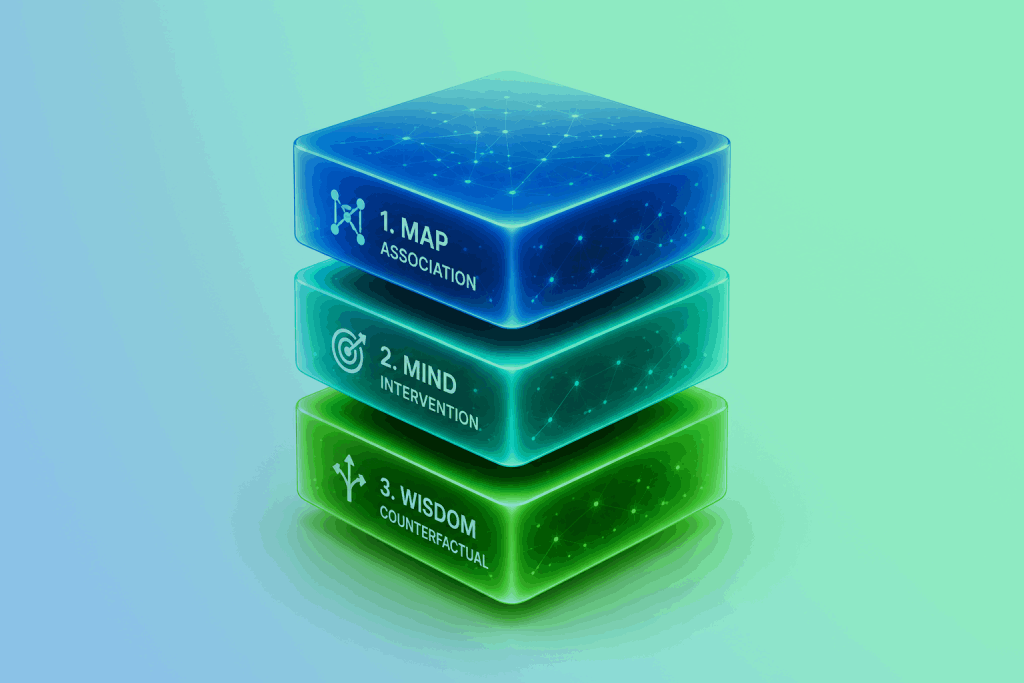

![Decision AI: Modern Decision Intelligence Stack [Part 2 of 2]](https://cdn.prod.website-files.com/69079d5bc1a99349b566161a/69b293b82dc44eb19c6ba0d7_thumbnail%20short%202.png)
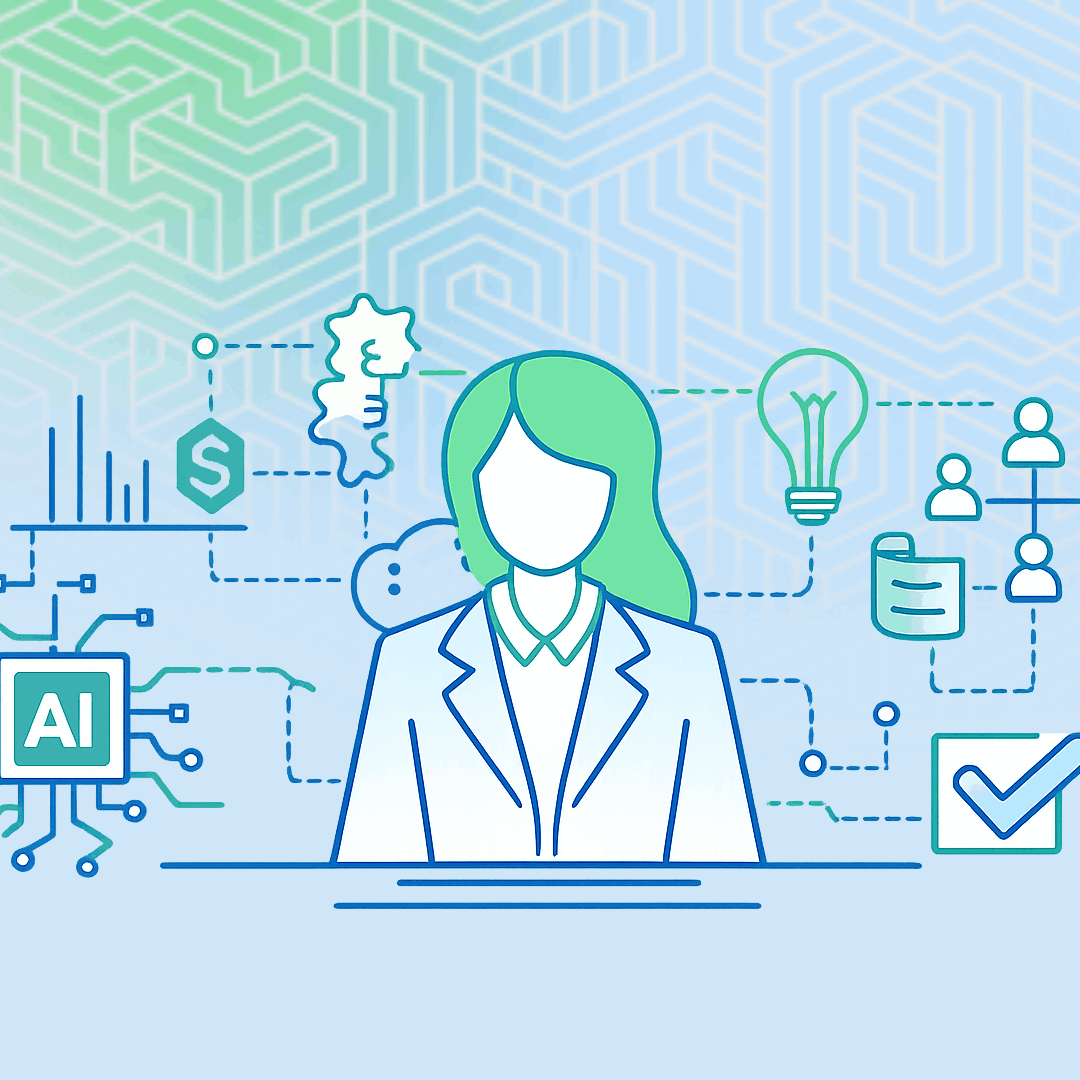
.png)
.png)
.png)
.png)
.png)
At the start of 2025, it was clear enough that Enterprise needs a Context Layer for decision intelligence.
LLMs struggled to go beyond PoCs as there was no mind map for it to reason across the ocean of organisational Data. It was inevitable to build Ontology. But there were two key problem statements while building Ontology for Enterprise.
Problem 1 :
In the real world, Enterprises don’t operate as linear decision pipelines.They operate as living cognitive systems. Learning happens when outcomes diverge from goals, with feedback propagating in parallel across: Reasoning → Inference → Decisions → Actions.
Modeling decisions alone will always fall short. This requires a self-learning Cognitive Ontology powered by AI reasoning.
Problem 2 :
Enterprise context doesn’t live in one place. It’s fragmented across structured data, systems, documents, and people’s heads. Building a context layer once is hard.
Knowing what’s missing and what to add next is harder.
Can building Ontology be as simple as chatting and uploading files and docs?
Introducing DecisionX’s Cognitive Ontology, a self-learning ontology with a built-in agent that helps enterprises build and evolve their ontology as they chat.
The DecisionX Ontology
A holistic Perspective of Building Context at Enterprise
Every enterprise, regardless of industry, size, or maturity can be understood through a single foundational structure:
People · Process · Product
×
Data · Reasoning · Inference · Decision · Action · Outcome
This is not a metaphor.It is a cognitive state-space.
Every meaningful enterprise activity from strategy formulation to frontline execution - exists somewhere within this matrix. If it can be reasoned about, acted upon, or measured, it occupies a coordinate in this space.
Understanding enterprises this way is the first step toward building true decision intelligence and AI decision making systems.
The DecisionX Ontology models this enterprise matrix explicitly using a small set of powerful, composable primitives:
- Entities — who and what exists
- Concepts — what things mean
- Processes — how work flows
- Objects — metrics, artifacts, and outputs
- Goals — desired future states
- Decisions — commitments made under constraints
- Actions — execution in the real world
- Outcomes — observed results
Every element in the ontology is interpreted through fundamental dimensions of context:
- Time
- Location
- Taxonomy
- Governance
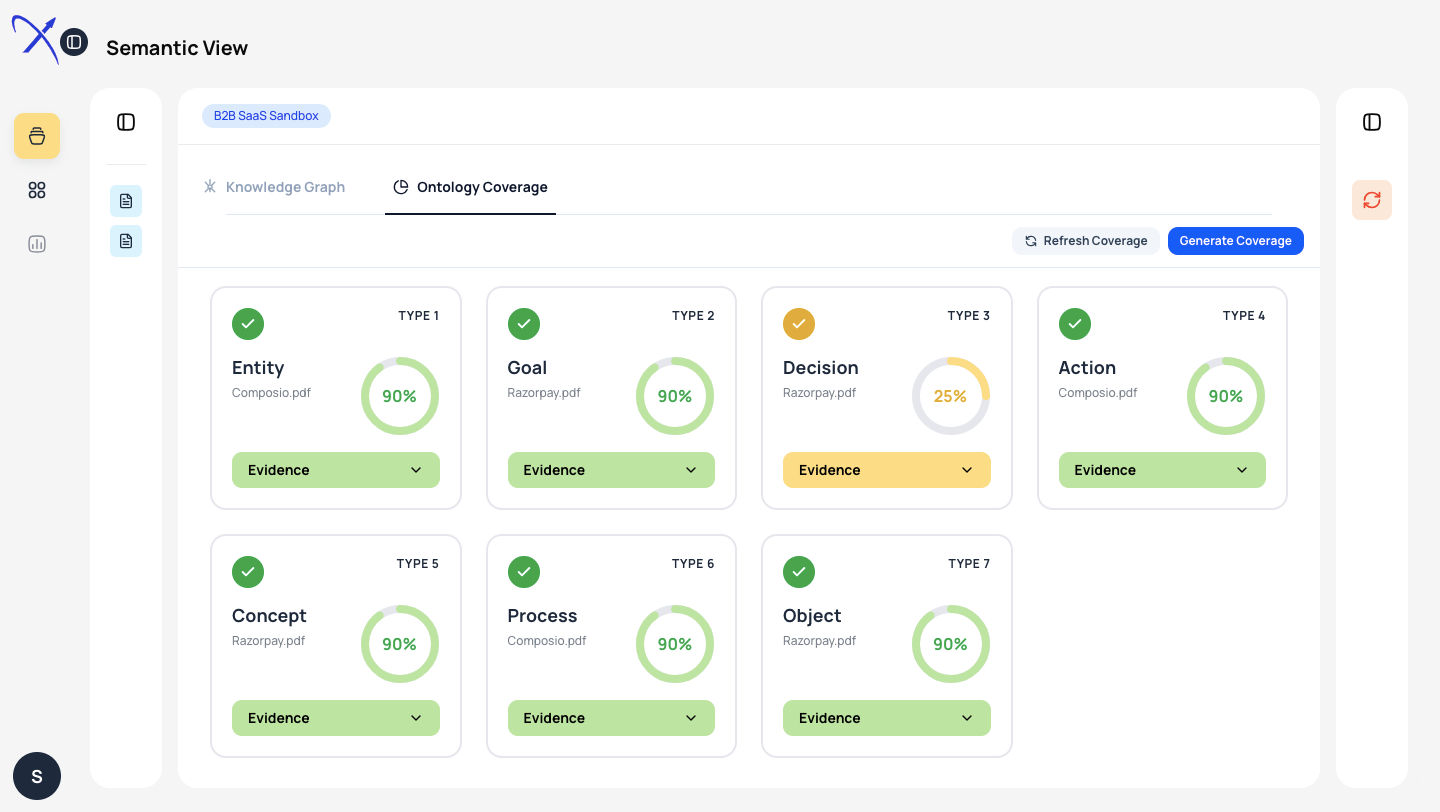
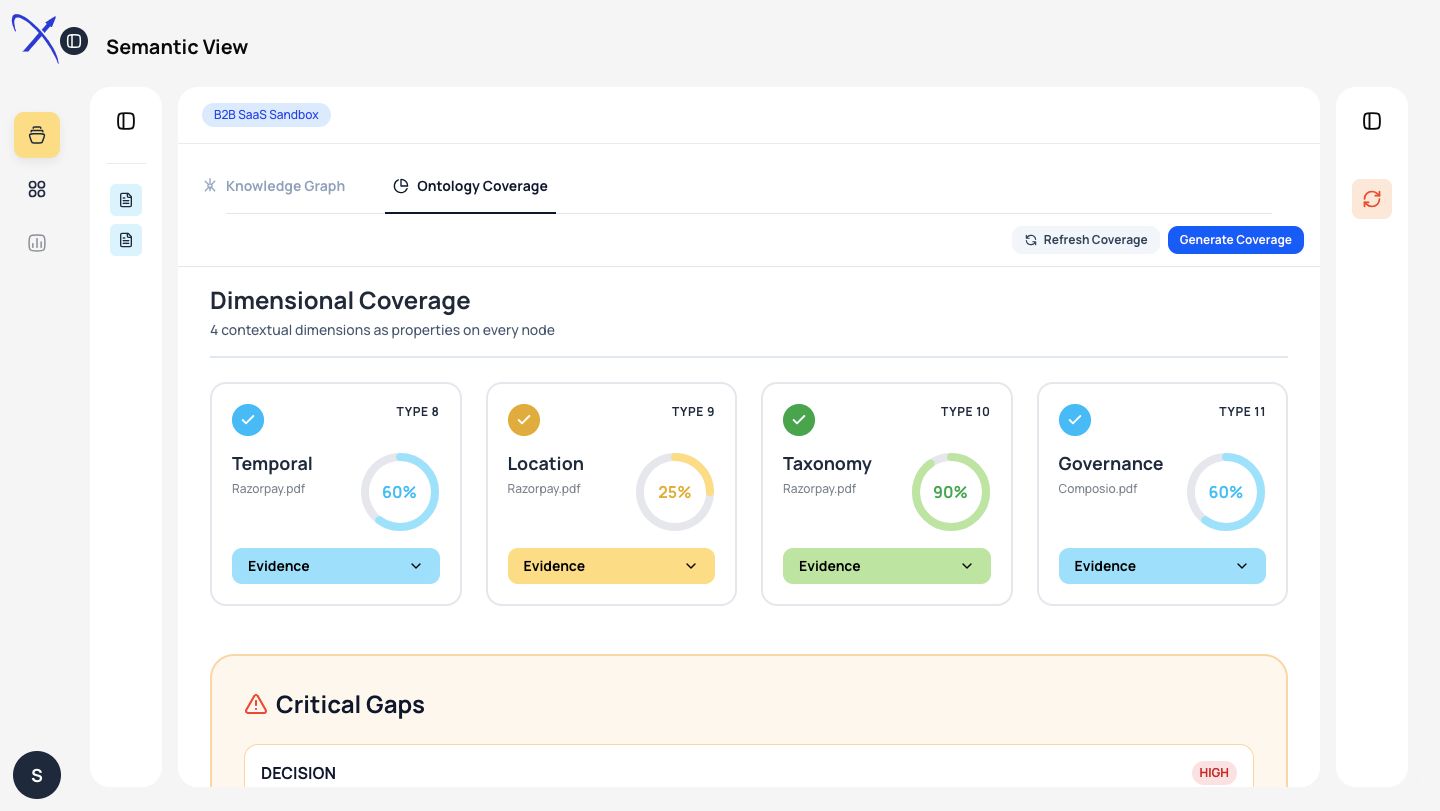
This is where context graphs belong - not as a standalone layer, but inside a broader ontology of enterprise cognition, understanding truly the causal relationship between the Static and Dynamic components ( both what and why ).
Context is not an add-on.
It is a property of how enterprises think.
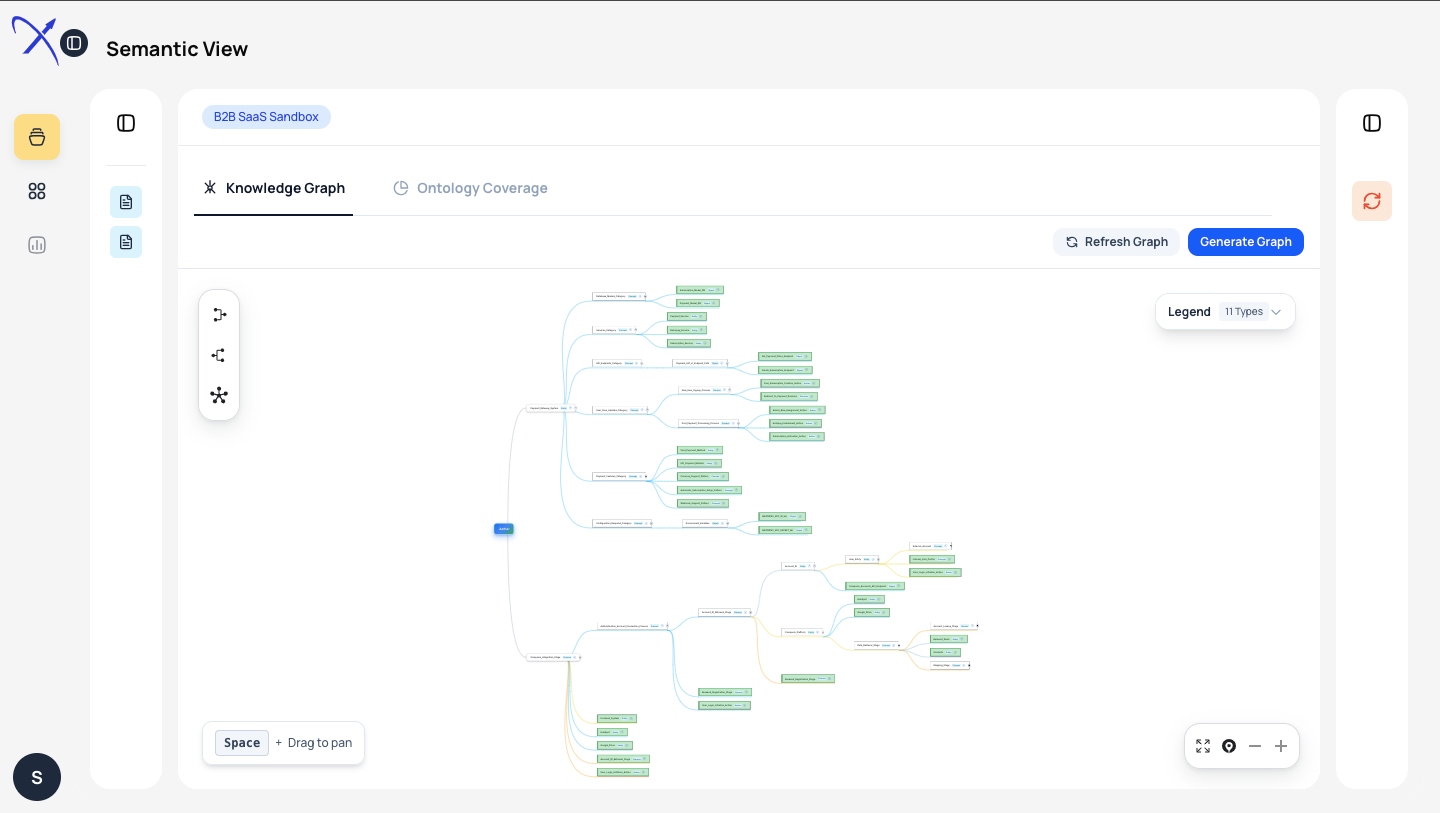
DecisisonX Ontology Building Agent
The DecisionX Ontology Building Agent automatically transforms enterprise data into a structured, evolving understanding of how decisions are made.
As soon as data is connected tables, files, or documents, the agent begins organizing it into DecisionX’s cognitive framework, identifying key entities, decisions, goals, signals, and outcomes. Within minutes, it performs deep analysis across datasets to uncover correlations, causal relationships, and anomalies, building a semantic model of cause–effect and historical decision behavior.
Building the Ontology first time is one thing, but in reality Data & Context availability at Enterprise is messy. Data teams dont know what file to add, what's the gap.
Decision X Ontology Agent solves for this.
The agent evaluates ontology coverage, highlighting missing context and recommending additional data or documents needed to improve reasoning. Teams can update the ontology by uploading files or simply chatting with the agent, allowing the ontology to continuously learn and evolve with the business.
The Self Learning Breakthrough
%20(3)%20(1).jpg)
The defining difference of the DecisionX Ontology is simple and profound:
Outcomes are first-class citizens.
- Every action produces an outcome
- Every outcome feeds back into the ontology
This is the foundation of self-learning AI for enterprises. As outcomes accumulate, the enterprise’s internal understanding evolves:
- Concepts gain or lose confidence
- Decisions refine judgment
- Processes reflect operational reality
- Goals recalibrate expectations
Learning becomes:
- Explicit
- Traceable
- Explainable
Nothing is hidden in opaque model weights.
Nothing resets every quarter. Its not about the Day 0 static structure of your Enterprise Ontology. Its about the dynamic adjustment and Learning across Reasoning -> Inference -> Decision -> Action → Outcome
How This Powers Green
Green is not an LLM sitting on top of dashboards. Green reasons through the ontology enabling Multi Layered Reasoning, being able to answer strategic Questions like - I want to increase sales by 20%, Suggest me plan and paths.
When Green answers a question, it:
- Understands enterprise structure (the Enterprise Matrix)
- Traverses concepts, decisions, and processes
- Evaluates goals and constraints
- Proposes actions — not just insights
- Learns from outcomes over time
Green doesn’t just respond. Green reasons.
That is the difference between Generic AI and the Context Aware, Self Learning - AI analyst. That's Green.

Ranjan Kumar, Founder & CEO, DecisionX
Ranjan Kumar is the Founder and CEO of DecisionX AI, the world’s first self-learning, context-aware Decision Intelligence platform that enables enterprises to make smarter, faster business decisions through agentic AI. A serial entrepreneur and three-time founder with over 17 years of experience, Ranjan previously built Entropik, the world’s first Emotion AI platform with 17 global patent claims. An IIT Kharagpur alumnus, he is widely recognized as a thought leader in enterprise AI, Ontology Engineering, decision reasoning, and AI-driven business transformation.