Decide Smarter.
Start Today
Popular Articles


![Decision AI: Modern Decision Intelligence Stack [Part 2 of 2]](https://cdn.prod.website-files.com/69079d5bc1a99349b566161a/69b293b82dc44eb19c6ba0d7_thumbnail%20short%202.png)

.png)
.png)
.png)
.png)
.png)
Introducing Reasoning Mode by DecisionX
Most strategy meetings don’t stall because of missing data. They stall because of missing clarity. I’ve sat in enough quarterly reviews to see the pattern. Dashboards are live. Metrics are tracked. Reports are automated.
Revenue dips and ten explanations surface. Pipeline slows and every function has a theory. Capital allocation debates stretch across meetings - but rarely end with conviction.
The problem isn’t visibility. It’s structured reasoning.
Analytics Solved the “What.” Strategy Still Struggles With “Why.”
When we built Green, our first priority was unification. Bring revenue, marketing, sales, and operational signals together. Surface changes instantly. Remove dependency on manual analyst cycles.
That layer matters. But as teams matured, the questions matured too.
They weren’t asking:
“What changed?”
They were asking:
- Is this causal or correlated?
- If we shift pricing, what happens to pipeline quality?
- Is this slowdown demand-side or execution-side?
- What trade-offs are we implicitly making?
- What happens next if we act?
Those are not reporting questions. They are reasoning questions.
Peter Drucker once wrote,
Management is doing things right; leadership is doing the right things
Analytics helps you operate efficiently. Strategy demands deciding what the right move is — under uncertainty. And that requires more than charts.
The Hidden Friction in Strategic Decisions
In most organizations, reasoning is still manual. It happens in meetings. In Slack threads. In decks stitched together across teams. Revenue drivers sit in one system. Marketing signals in another. Operational constraints somewhere else. Assumptions scattered across conversations.
Herbert Simon warned that
“a wealth of information creates a poverty of attention”
I’d add something more specific. A wealth of metrics without structured reasoning creates slow decisions. Not because leaders lack intelligence - but because the logic behind decisions isn’t system-supported.
And slow decisions compound.
Why We Built Reasoning Mode
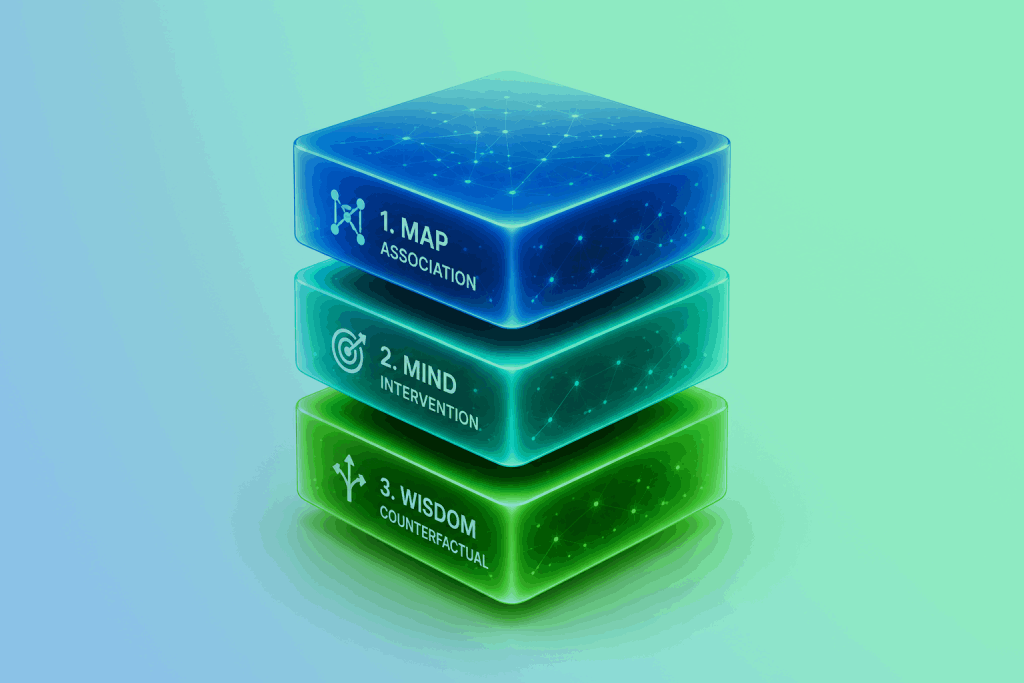
Reasoning Mode is our answer to that gap. Green began as a context-aware AI Analyst - unifying signals and surfacing performance shifts. With Reasoning Mode, it evolves into a structured strategic reasoning engine.
Now Green can:
- Trace causal relationships across functions
- Run correlations across revenue drivers
- Structure root cause explicitly
- Forecast downstream impact
- Evaluate trade-offs before capital is committed
- Optimise across drivers intentionally
All within the same unified environment teams already use. No stitching logic across slides. No fragmented assumptions. No waiting on separate modelling cycles.
Reasoning becomes embedded, not improvised.
From Insight to Decision-Grade Clarity
There’s a difference between insight and decision-grade clarity.
Insight informs. Decision-grade clarity aligns. When drivers, assumptions, and trade-offs are structured clearly:
- Alignment improves.
- Conversations shorten.
- Execution accelerates.
In high-growth environments, the speed and coherence of reasoning often determine outcomes more than the quantity of data available.
Charlie Munger once said,
“Show me the incentive and I will show you the outcome.”
Strategic reasoning is about understanding those drivers beneath the metrics, not just the metrics themselves. Dashboards describe performance. Reasoning shapes decisions.
The Next Layer of Strategic Advantage
We are entering an era where every company has access to data. The differentiator will not be who has more dashboards. It will be who reasons better.
Green started by giving teams visibility. With Reasoning Mode, it adds structure to strategic thinking. Not replacing human judgment, but strengthening it.
Because strategy isn’t about having answers.
It’s about making better decisions - repeatedly, under complexity.
Data is abundant. Reasoning shouldn’t be scarce. Over the next few weeks, I’ll be sharing how we’re evolving Green from an AI Analyst into a full Decision Intelligence platform. If you care about how modern strategy should operate in the age of data abundance, stay tuned.
The next layer of strategic advantage won’t come from more dashboards. It will come from better reasoning leading to clearer Decisions.


Ranjan Kumar, Founder & CEO, DecisionX
Ranjan Kumar is the Founder and CEO of DecisionX AI, the world’s first self-learning, context-aware Decision Intelligence platform that enables enterprises to make smarter, faster business decisions through agentic AI. A serial entrepreneur and three-time founder with over 17 years of experience, Ranjan previously built Entropik, the world’s first Emotion AI platform with 17 global patent claims. An IIT Kharagpur alumnus, he is widely recognized as a thought leader in enterprise AI, Ontology Engineering, decision reasoning, and AI-driven business transformation.